Business Challenge
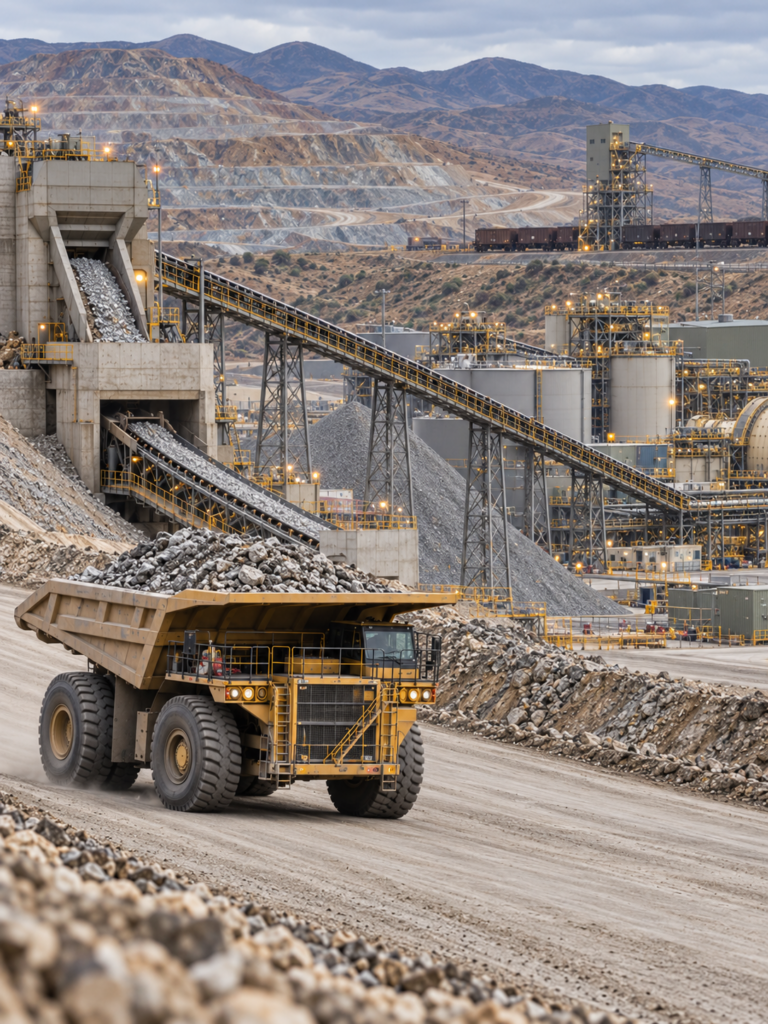
The proposed copper-gold mine, processing facilities and logistics operations appeared capable of meeting their individual design targets. The challenge was to establish whether the complete mine-to-market system could also achieve the planned production capacity.
Downtime, storage limitations and the timing of material movements can constrain production even when each operating area meets its design target. The assessment therefore needed to identify the achievable capacity of the integrated operation and determine what equipment and operating changes would be required to meet the production target.
Simulation Solution
An integrated discrete-event simulation connected mine dispatch, crushing, stockpiles, processing and concentrate logistics in a single production system. Material flows, changing ore grades, equipment availability and storage constraints were represented together, allowing disruptions to propagate between operating areas.
The mining and haulage model represented truck and shovel cycles, ore destinations, haul distances and availability. Crushing and storage included run-of-mine reclaim, surge buffers and stockpile management. Processing covered grinding, flotation, recirculation, grade recovery and downtime, while logistics included product inventory, road variability, dispatch and delivery.
Alternative equipment configurations, truck fleet sizes, storage capacities and maintenance strategies were evaluated iteratively. Equipment criticality and sensitivity analyses examined which assets and operating constraints had disproportionate effects on overall production.
Key Findings
The integrated production capacity assessment identified a potential 2% shortfall relative to design capacity. This modelled result showed why adequate capacity in individual operating areas did not guarantee that the combined system would achieve the production target.
Equipment criticality analysis identified eight high-impact assets. These findings provided a basis for focusing reliability and equipment decisions on assets with the greatest influence on system performance.
Truck fleet requirements were established across alternative mine plans and operating scenarios. Fleet sizing was evaluated together with storage capacity and equipment reliability, helping define the equipment and operating configuration needed to achieve planned production.
Outcomes
The analysis supported engineering and production decisions on truck fleet sizing, storage requirements, equipment configurations and maintenance strategies. Alternatives were tested until the modelled system achieved the design target.
By assessing the complete mine-to-market operation, the study revealed constraints that were not apparent from individual design capacities. The results supported targeted decisions about fleet requirements, storage buffers and equipment reliability, with their effects evaluated against overall production.
Download Case Study (PDF)