Business Challenge
A shipper entering a shared bulk-export terminal needed to understand whether the commercial terms proposed by the port operator would protect its shipments and upstream production.
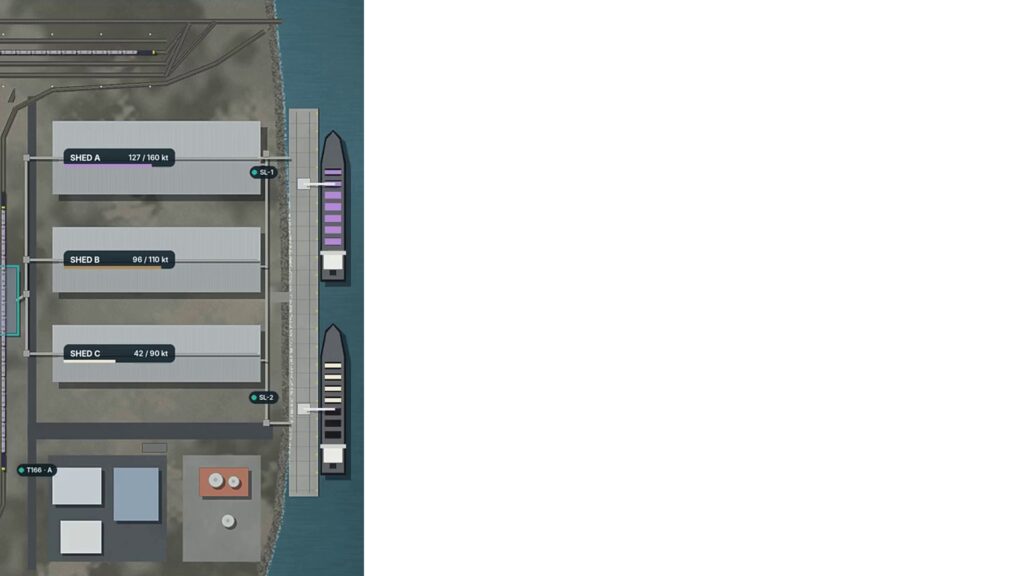
The terminal had to coordinate rail arrivals, stockyard inventory, handling equipment and vessel schedules across multiple customers and commodities. Competition for shared resources could disrupt shipments and put mine production at risk. The shipper needed to establish which service terms and guarantees mattered most, and what each concession was worth.
Simulation Solution
MISIM developed an integrated rail-to-vessel model that ranked the proposed commercial terms by their impact on the shipper’s operation. As negotiations progressed, the model quantified the concessions offered by the port operator, giving the shipper an evidence-based position.
The simulation represented train arrivals, shared trackage, crew handover, unloading sequences and priority rules. It connected these activities with stockpile storage, direct-hit opportunities, equipment washdown, berth sequencing, shiploading and vessel queue priorities.
More than 1,000 trains and vessels per year and over 30 handling assets were represented, including equipment downtime and metocean conditions. The model captured competition for yard space and shared unloading and handling equipment, movements from staging tracks to unloading spots, and time-based priorities for trains and vessels. Sensitivity runs tested rail service, priority rules, vessel handling requirements and third-party traffic.
Key Findings
The analysis identified up to $7.5 million in potential annual demurrage reduction.
It also identified a potential 3% terminal-capacity shortfall and assessed $100 million in potential net present value exposure associated with mine production. These were modelled risks and opportunities, rather than reported realized savings.
Outcomes
The shipper could compare proposed commercial terms and quantify concessions as negotiations evolved. This helped it negotiate from an informed position, with the consequences for shipments and upstream production evaluated together.
The study showed that contractual priorities at a shared terminal can matter as much as physical capacity. Integrated simulation provided a way to test service terms and guarantees before taking on the commercial risk.