Project Challenge
The proposed Albemarle Kemerton Lithium Hydroxide Plant required reliable process capacity and practical truck movements across a constrained industrial site. Equipment configuration, surge storage and downtime needed to be evaluated alongside loading times, truck queues and parking requirements.
The design study addressed both production performance and site logistics. Its objective was to validate process capacity and reliability, confirm equipment and storage requirements, and test traffic flow, loading, queuing and parking arrangements before operation. Two dynamic models provided a quantitative basis for refining the process design and site layout during engineering.
Modelling Approach
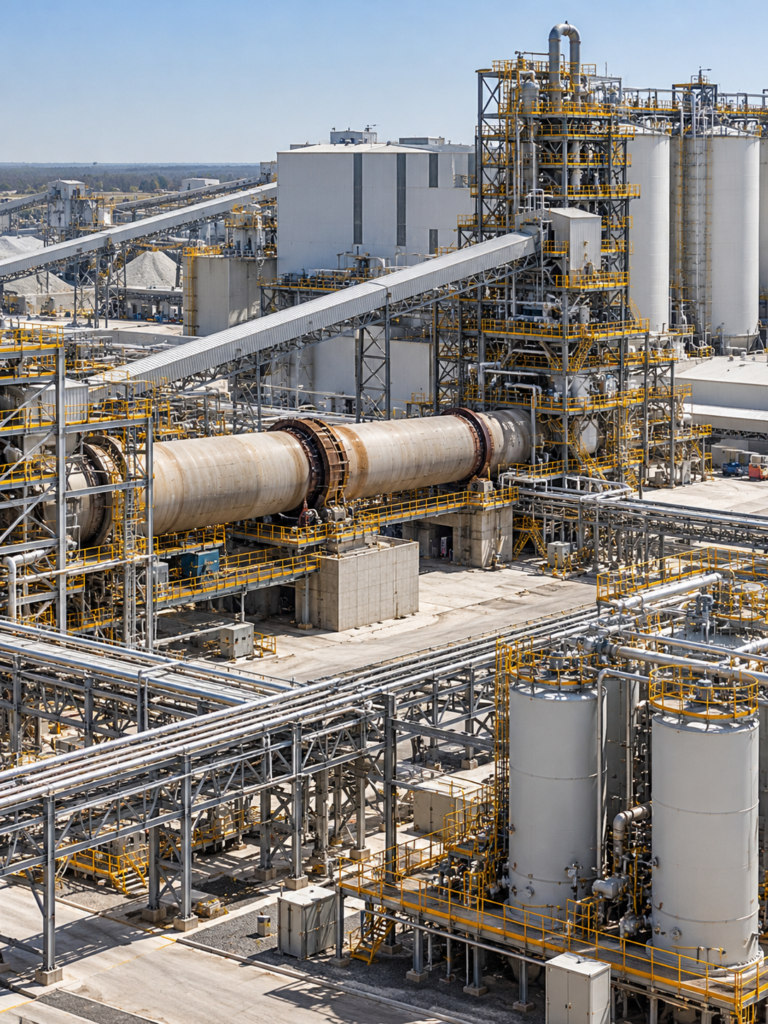
The process simulation represented mass flows from spodumene receipt through to product and tailings. It examined equipment configuration, flow rates, downtime, buffers and storage to understand process bottlenecks and sensitivity to equipment reliability.
Alternative equipment, storage, flow-rate and downtime assumptions could be tested to evaluate their implications for plant performance. This supported assessment of how available capacity and surge storage interacted with interruptions in the process.
The traffic model represented four inbound materials and three outbound products transported by truck. It tracked complete truck cycles through gates, weigh scales, loading and unloading areas, queues and parking. Modelling the full cycle helped identify congestion and define queuing requirements, rather than considering each site activity in isolation.
Decisions Supported
Process results supported validation of surge volumes and equipment sizing. The analysis tested bottlenecks and reliability sensitivities, providing information for decisions about plant configuration, storage and operating modes.
Truck-cycle results informed traffic circulation and loading-area arrangements. They also supported refinement of queuing, parking and site-footprint requirements. These decisions considered how truck movements and service times affected the use of available space within the industrial site.
Together, the two models supported examination of process and logistics design questions before operation. Equipment and storage alternatives could be assessed alongside practical requirements for receiving materials and moving products off site.
Outcomes and Applications
The simulations provided a quantitative basis for refining process design and site arrangements. A configurable process model was delivered for subsequent analysis, allowing further investigation of equipment, storage, flow-rate and downtime alternatives.
The central finding was that equipment capacity alone does not establish a workable plant design. Reliability and storage limits need to be considered alongside truck arrivals, queuing and circulation. Dynamic simulation revealed constraints that steady-state calculations and layout drawings could overlook, supporting decisions about both process performance and site logistics during engineering design.
Download Case Study (PDF)