Most warehouse optimization projects start with a drawing. A new rack layout, a second mezzanine, a goods-to-person system, six more dock doors. The drawing looks right, the spreadsheet says throughput will rise, and capital gets approved. Then the building goes live and the pick faces congest at 2 p.m., trailers queue in the yard, and the labor plan misses by 15%.
MISIM helps operators avoid that outcome. Through our simulation consulting work, we build a working model of your warehouse that tests how labor, slotting, and dock flow interact under real demand before anyone moves a rack. This guide explains why warehouse optimization so often underdelivers and how MISIM approaches it differently.
Why Warehouse Optimization Projects Underdeliver After the Layout Changes
Warehouses rarely fail because a single process is badly designed. They fail at the handoffs. Receiving feeds putaway, putaway feeds storage, storage feeds picking, picking feeds packing, and packing feeds the outbound dock. Each step can look fine on its own and still choke the building when they compete for the same people, aisles, and doors.
Traditional warehouse optimization tools struggle with these interactions for a few reasons.
Labor plans are built on averages
Engineered labor standards and spreadsheet models usually divide forecast volume by an average pick rate. That works on an average day. It breaks when order profiles shift by hour, when a wave drops 40% of the day’s lines into a two-hour window, or when absenteeism hits the same shift as a late inbound trailer. Labor is also the input that most operations have the least room to adjust. The 2026 MHI Annual Industry Report, produced by MHI and Deloitte, found talent shortages affecting 90% of supply chain organizations, so a warehouse optimization plan that depends on hiring extra pickers at peak may never be staffable.
Slotting is decided one SKU at a time
Slotting tools rank items by velocity and cube, then assign the fastest movers to the most accessible locations. The logic is sound for each SKU in isolation. What it misses is that concentrating fast movers in one zone can put six pickers in the same aisle at once, starve replenishment, and create the congestion the re-slot was meant to remove.
Dock schedules ignore the yard and the floor
Appointment schedules often treat each door as independent. In practice, a door is only as productive as the staging lane behind it, the forklift that clears it, and the yard driver who brings the next trailer. When inbound and outbound share doors, staff, or staging space, a 30-minute slip in receiving can push outbound cut-off times late in the afternoon.
None of these problems shows up in a static model. They emerge from variability, shared resources, and timing, which is exactly where warehouse optimization decisions carry the most risk.
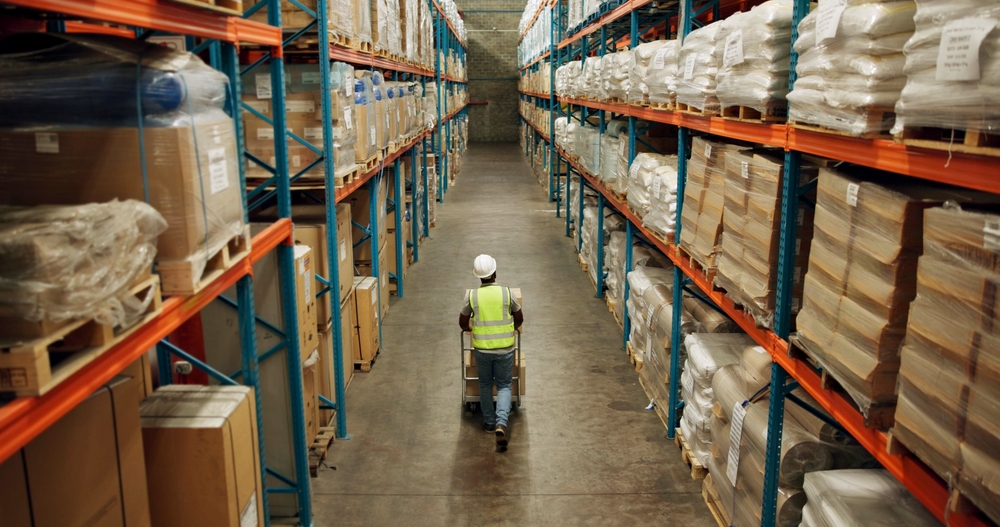
What Effective Warehouse Optimization Needs Before Anyone Moves a Rack
Effective warehouse optimization treats the building as one connected system. The question is how much volume the whole operation can reliably move, by hour, under the demand and disruptions it will actually face, rather than how fast each process runs on its own.
Answering that question takes a model that represents individual orders, people, equipment, locations, and trailers moving through the facility over time. This is what discrete-event simulation does. It reproduces the sequence of events in a warehouse, from a trailer arriving at the gate to a carton leaving on an outbound load, with the randomness real operations contain. If you are deciding whether you need a full digital twin or a focused simulation study, our guide on scoping the right model covers that choice.
A model built for warehouse optimization should be able to show:
- Throughput by hour and by shift, including whether outbound cut-offs are met on peak days
- Labor utilization and idle time by function, zone, and shift
- Aisle and pick-face congestion under different slotting strategies
- Dock door, staging lane, and yard occupancy across the day
- Order cycle time and how it changes when demand, product mix, or staffing changes
- The binding constraint, and how that constraint moves as conditions change
That last point matters most. In complex operations the bottleneck often shifts. On a normal Tuesday it might be packing. During a promotional peak it may move to replenishment, and during a heavy inbound week it may move to the dock. Warehouse optimization built on a single assumed bottleneck can spend capital in the wrong place. The same logic sits behind sound capacity planning with simulation, where the goal is finding what the system can reliably deliver rather than its nameplate rate.
How MISIM Approaches Warehouse Optimization Differently
MISIM’s team of engineers, mathematicians, and simulation specialists has spent more than 30 years modeling complex industrial systems, and our work has been recognized with the INFORMS Franz Edelman Award. We bring the same discipline to warehouse optimization that we apply to mine-to-port supply chains and marine terminals.
We start with the decision. Before building anything, MISIM works with your team to define the question the model must answer. That might be whether a proposed layout can meet 2028 peak volume, how many dock doors a new building needs, or whether an automation investment pays back at your actual order profile. A model framed around a real decision stays focused and gets used.
We model the whole building as one system. MISIM connects receiving, putaway, storage, replenishment, picking, packing, shipping, and the yard in a single model. People, forklifts, aisles, and doors are shared resources, so the model shows what happens when they compete.
We build in real variability. Order arrival patterns, product mix, pick times, equipment downtime, absenteeism, and late trailers are represented as distributions drawn from your data. Your warehouse optimization results then reflect a realistic month of operations instead of one ideal day.
We validate before anyone relies on it. MISIM tests every model against historical operating data and the knowledge of the people who run the floor. If the model can’t reproduce last November’s peak, it isn’t ready to predict next November’s. Our approach to building simulation models people can trust applies here in full.
We report ranges, not a single number. Leadership gets throughput, labor, and service results as probability ranges, along with a ranked list of constraints and the trade-offs between options. That gives a capital committee something defensible to approve.
We build the smallest credible model. MISIM scopes the model to the decision. A dock sizing question doesn’t need every SKU in the building, and a slotting question doesn’t need a detailed yard. Keeping scope tight keeps cost and timelines proportionate to the value at risk.

How MISIM Models Labor in Warehouse Optimization Studies
Labor is usually the largest operating cost in a warehouse and the hardest to flex. MISIM models labor as a set of individual workers with skills, shift patterns, breaks, travel paths, and task priorities, rather than as a headcount divided into volume.
That level of detail lets the model answer questions a labor standard can’t. How many pickers does the building need by hour to hit cut-off on the 95th percentile day? What happens to cycle time if two receivers call in sick on a heavy inbound morning? Does cross-training packers to pick shorten the afternoon peak or just move the queue? Would a later shift start reduce overtime without hurting outbound service?
MISIM also tests labor interactions with layout. Travel distance, aisle congestion, and wait time for replenishment all erode productivity, and they change when the layout changes. A warehouse optimization study that models labor separately from layout will overstate the benefit of almost any new design. Our wider work on resource allocation with simulation follows the same principle: people, equipment, and space have to be sized together.
The output is a staffing plan by function and shift that the operations team can test against its own scenarios, including the hiring constraints it actually faces. For warehouse optimization programs with a labor reduction target, MISIM shows which savings are real and which simply push work into overtime or a later shift.
How MISIM Models Slotting and Storage Before You Re-Slot
Slotting changes are tempting because they look cheap. Moving product costs labor rather than capital, so re-slots often happen with little analysis. Yet a poor re-slot can cost a peak season of lost productivity. Treating slotting as part of warehouse optimization, with the same testing as a capital change, is one of the simplest ways to protect peak performance.
MISIM tests slotting strategies inside the full warehouse model so their effects on the rest of the operation are visible. We compare options such as velocity-based golden zones, family grouping, split forward pick areas, and demand-driven slotting against the same demand profile. For each one, the model shows pick travel, aisle congestion, replenishment frequency, and the knock-on effect on packing and shipping.
Storage capacity is modeled alongside slotting. MISIM tests rack and shelving configurations, reserve storage locations, and the number of pick faces each zone can hold as SKU counts grow. That matters for operations planning a warehouse optimization program ahead of a product range expansion or a new channel, where the SKU base may double within a few years.
For operators weighing automation, the same model can compare a manual layout with shuttle systems, autonomous mobile robots, or goods-to-person stations. MISIM’s role is to show what each option delivers at your order profile, independent of any equipment vendor’s throughput claims.
How MISIM Models Dock Flow, Yard Moves, and Trailer Timing
The dock is where a warehouse meets the rest of the supply chain, and it’s where small timing problems compound. MISIM models trailer arrivals, gate processing, yard moves, door assignment, unloading and loading times, staging lane capacity, and the forklifts and people that serve each door.
That model can answer the dock questions that drive capital and service decisions. How many doors does the building need to meet target truck volume? Should inbound and outbound share doors or be separated? How much staging space does the outbound dock need to protect carrier cut-off times? What does a two-hour carrier delay do to the rest of the day?
MISIM has modeled rail-connected logistics facilities where truck loading, rail operations, weigh scales, and warehouse storage all interact, so we understand how dock and yard constraints shape building performance. For facilities that sit inside a larger network, dock flow can be linked to upstream and downstream movements, which ties warehouse optimization to broader supply chain optimization decisions.
Dock modeling is often where warehouse optimization pays back fastest. Adding doors is expensive and sometimes impossible on an existing site, so MISIM tests operating changes first: appointment windows, door assignment rules, live versus drop trailer policies, and staging lane allocation. If those changes recover enough capacity, the capital request shrinks or disappears.

What a MISIM Warehouse Optimization Engagement Looks Like
Every MISIM engagement is scoped to the decision, but most warehouse optimization projects follow a similar path. Where it helps, we structure the work around our DIVES methodology (Define, Implement, Validate, Evaluate, Synthesize), and you can see how it works in practice on our How It Works page.
- Frame the decision. MISIM meets with operations, engineering, and finance to agree on the question, the options to compare, the KPIs that matter, and the value at risk.
- Gather the data you already have. We work from your warehouse management system, labor management system, ERP, yard management data, order history, layout drawings, and the spreadsheets your planners use today. Imperfect data is normal. MISIM starts with what exists and flags where better data would change the answer.
- Build the model. MISIM builds a discrete-event simulation of the operation at the level of detail the decision requires, with animation so your team can watch the building run.
- Validate with your team. We compare model results to historical performance and walk supervisors and engineers through the logic until they agree it behaves like their warehouse.
- Test the scenarios. Layout options, staffing plans, slotting strategies, dock configurations, automation alternatives, demand growth, and disruption cases are run side by side.
- Deliver decision evidence. MISIM presents results as throughput and service ranges, cost trade-offs, ranked constraints, and clear recommendations, with outputs that feed directly into your business case.
Many clients keep the model after the first study and use it for later decisions, such as the next peak plan or the next phase of an expansion. That reuse is where warehouse optimization starts to compound, because each new decision builds on a model the team already trusts.
When MISIM Warehouse Optimization Makes More Sense Than a Spreadsheet or Vendor Tool
Spreadsheets, WMS reports, and dashboards in Power BI or Tableau describe past performance well, and MISIM uses them as model inputs. Simulation adds the ability to test conditions your building hasn’t seen yet. MISIM’s warehouse optimization work adds the most value in these situations.
When capital is about to be committed. New buildings, expansions, mezzanines, and dock additions are expensive to reverse. Testing them first is cheap by comparison, and it is central to de-risking capital investment decisions of any size.
When an automation business case depends on throughput claims. Vendor simulations are built to sell equipment. An independent MISIM model tests the claim against your order profile, labor, and building constraints.
When volume growth or a new channel is coming. A move into direct-to-consumer orders or a large new account changes order profiles enough that last year’s averages stop applying.
When congestion persists and nobody agrees why. If operations, engineering, and finance each blame a different area, a validated model settles the argument with evidence.
When the warehouse is part of a larger system. Port-adjacent warehouses, rail-served facilities, and plant warehouses depend on upstream and downstream timing that a standalone tool can’t capture.

Industries and Facilities MISIM Supports With Warehouse Optimization
MISIM applies warehouse optimization across the facility types where storage and handling sit inside a larger, higher-stakes operation:
- Distribution centers and fulfillment operations serving retail, wholesale, and direct-to-consumer channels
- Third-party logistics warehouses balancing several clients with different order profiles in one building
- Rail-connected and port-adjacent logistics facilities where warehouse, truck, rail, and marine timing interact
- Mining and process industry warehouses, including spare parts, consumables, and finished product storage
- Manufacturing plant warehouses that feed production lines and ship finished goods
- Healthcare supply and distribution operations where stock availability affects patient care
You can see the range of operations MISIM has modeled on our case studies page.
MISIM is headquartered in North Vancouver, British Columbia, and works directly with owners, operators, and engineering teams on major capital and operating decisions around the world. Our clients include multinational operators in mining, energy, and logistics, so we are used to working across sites, time zones, and stakeholder groups.
Other MISIM Solutions That Support Warehouse Optimization
Consulting is often where a warehouse optimization project begins, but it connects to the rest of what MISIM does.
Our digital twins and simulation work builds models that can live alongside the operation and be updated as layouts, volumes, and processes change. For a warehouse, that means a reusable test environment for every future decision instead of a one-off study.
If your organization already has a warehouse or network model built internally or by another firm, MISIM’s model audits check whether it can carry the weight of the decision it’s being used for. We review assumptions, logic, data, and validation, then tell you where the model can be trusted and where it can’t.
Through model custodianship, MISIM maintains and governs your model over time, so it stays accurate after the next re-slot, the next shift change, or the next expansion phase. Together, these services keep every warehouse optimization decision tied to a model the business can rely on.

Warehouse Optimization With MISIM: FAQs
What does MISIM do in a warehouse optimization project?
MISIM builds a discrete-event simulation of your warehouse that connects labor, slotting, storage, and dock flow in one model. We use it to test layout, staffing, automation, and dock options against realistic demand, then deliver throughput and cost ranges your leadership team can use to make the decision. Every warehouse optimization result is validated against your historical performance before it is used.
How is MISIM’s warehouse optimization different from a WMS or slotting tool?
A WMS runs daily execution and a slotting tool ranks SKUs by velocity. MISIM models how the whole building behaves over time, including congestion, shared resources, variability, and disruptions. We use data from those systems as inputs, so the model complements the tools you already have.
What data does MISIM need to start a warehouse optimization study?
Typically order history, SKU master data, layout drawings, labor and shift data, equipment counts, and dock or yard records from your WMS, ERP, and labor management systems. MISIM can start with imperfect data and identify which gaps would materially change the answer.
How long does a MISIM warehouse optimization engagement take?
It depends on the decision. A focused dock or labor study can deliver results in weeks, while a full building model supporting an expansion takes longer. MISIM scopes the smallest credible model that answers your question, so timelines stay tied to the value at risk.
Can MISIM evaluate warehouse automation before we buy it?
Yes. MISIM compares manual and automated options, such as shuttles, autonomous mobile robots, and goods-to-person systems, against your actual order profile and building constraints. Because we don’t sell equipment, the analysis is independent of vendor throughput claims.
Does MISIM only work on new warehouses?
No. Much of MISIM’s work is on existing operations dealing with congestion, missed cut-offs, or rising labor cost. We also model greenfield buildings and expansions where the design still needs to be validated before capital is committed. Warehouse optimization on an existing site often pays back fastest, because the building, the data, and the team are already in place.
Who owns the warehouse optimization model MISIM builds?
Ownership terms are agreed at the start of each engagement. Many clients keep the model and use it for future peak planning and expansion phases, and MISIM can maintain it through our model custodianship service so it stays accurate as the operation changes.
How much does a MISIM warehouse optimization study cost?
Cost is matched to the decision and the value at risk. MISIM often starts with a targeted diagnostic and expands the model only when the value is clear. Contact our team with the decision you’re facing and we’ll outline a scope and estimate.
Warehouse Optimization With MISIM
A new layout, a re-slot, or more dock doors can each improve a warehouse, or they can move the bottleneck somewhere more expensive. The difference usually comes down to whether labor, slotting, and dock flow were tested together before the change was made.
MISIM gives operations and capital teams that test: a validated model of the building, run against real demand, with results leadership can act on. If your next warehouse optimization decision carries real capital or service risk, it’s worth seeing what the model shows first.